How can building societies and specialist lenders stay human in an AI-shaped market?
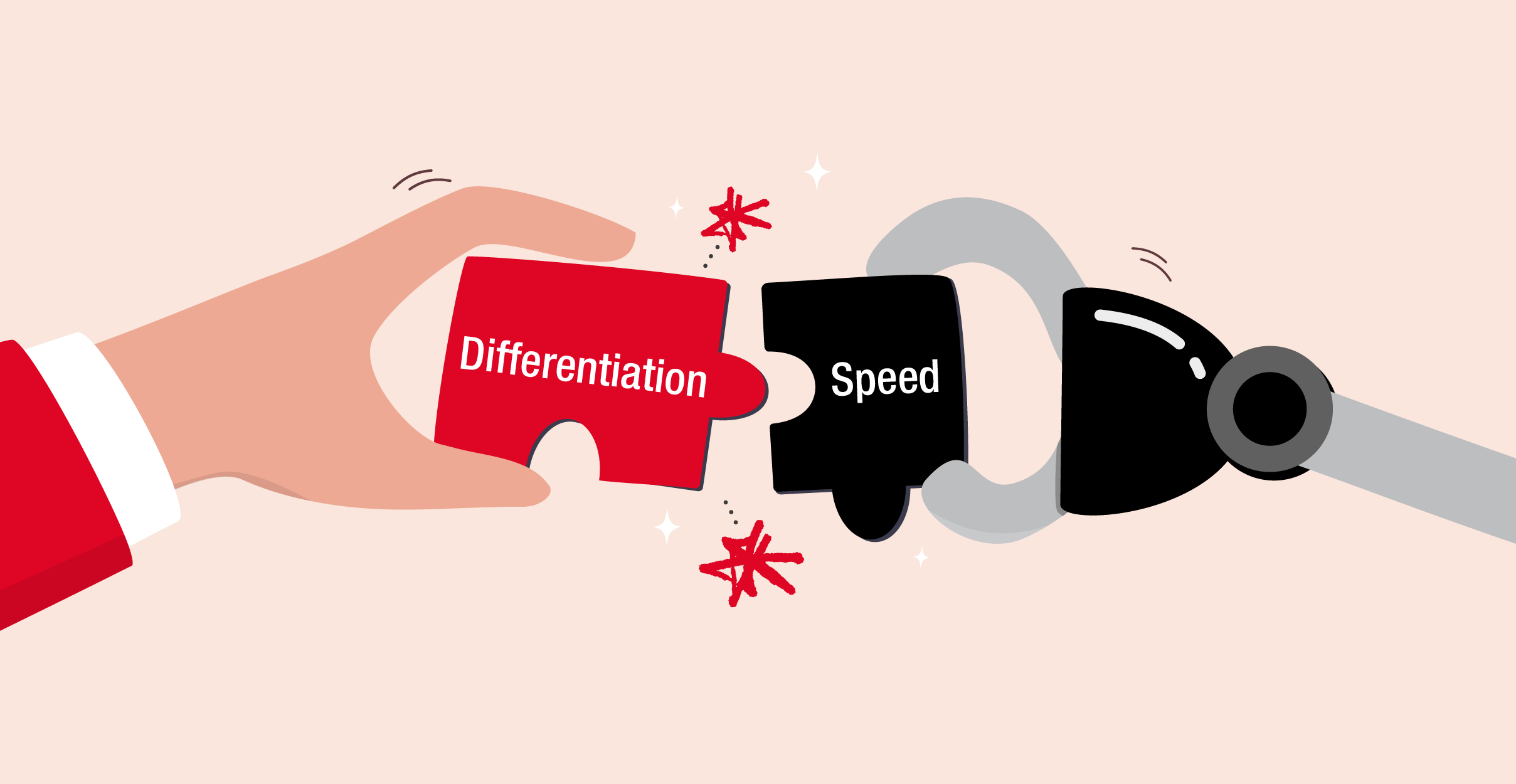
AI is changing how financial services marketing is made. It’s speeding up content production, improving service interactions and helping teams do more with less. But the danger is obvious: if every lender and building society uses the same tools trained on the same category language, the sector’s sameness problem is only going to get worse. The brands that benefit most from AI will be those with the clearest human foundations — a sharper purpose, a stronger point of view, a more distinctive voice and a better understanding of the people they serve.
Artificial Intelligence is something we’ve been thinking a lot about here at mark-making*, and in particular its implications for the financial services brands we work with. There’s no question that AI will make it easier for FS firms to say more, more often. But as we all know, more content doesn’t equal stronger brand. When it’s easier than ever to churn out content, the risk is that brands all start saying the same things, in the same way – at greater speed. And that’s a problem in a market where a lot of brands already sound the same anyway.
The point we want to make in this article is that for building societies and specialist lenders, the opportunity isn’t simply to use AI. It’s to use it without losing the clear human advantage and distinctive voice that makes them memorable and worth choosing.
Key takeaways
- AI will make FS marketing faster, but not automatically better.
- Generic positioning will lead to generic AI-generated content.
- Building societies have a powerful member-owned story, but it must be made meaningful.
- Specialist lenders are often built around deeply human customer circumstances.
- Strong brand strategy is what keeps AI-enabled marketing distinctive.
AI will change the speed of financial services marketing
AI will speed up financial services marketing pretty drastically. For some brands it’s already doing exactly that. Look at Klarna, for example. It’s revealed that its AI assistant handled 2.3 million conversations in its first month, two-thirds of customer service chats, and did the equivalent work of 700 full-time agents.
When the operational power of AI is that great, why wouldn’t you? It’s a no-brainer. The thing is, AI creates efficiency, but not automatic distinctiveness. It can help your firm move faster, but it can’t decide what your brand should stand for. Relying on it too heavily is to risk your brand ending up being generic, indistinguishable from all the others.
Speed is not the same as difference
As we’ve discussed elsewhere, there’s a risk inherent in sounding the same as every other brand. It means people can’t clearly explain why they like or choose you, and that means brokers and customers alike. It’s not surprising that this happens. It’s almost par for the course when an entire sector uses risk-aversion as a brand strategy.
But it’s not just ineffective. It’s actively damaging, because in a space where everything looks and sounds the same, the only differentiator left is price. And competing on price, in the long run, is a race nobody wins.
Think about all the different communication touchpoints people have with your firm: rates, criteria, affordability, product updates, application processes, broker portals, member benefits, service claims – the list goes on. These things matter, of course, but the language around them tends to be very similar from one firm to the next. And that language is functional and product-driven, not emotional. It’s the rational information that tends to come last in how humans actually make decisions.
So, however quickly you’re getting the comms out courtesy of AI, that speed isn’t going to help you when customers choose a competitor over you or brokers recommend another firm. Talk in a human way – meet people where their heads and hearts are and then back it up with the facts – and that’s half the battle won.
Why building societies and specialist lenders have a human advantage
To that end, building societies have a natural human advantage inherent in their DNA: mutuality and membership. They’re owned by members – customers – not shareholders. Their culture is focused on those members, and on communities. This gives them a powerful human story, but only if they express it clearly and distinctively. Mutuality on its own isn’t enough; it still has to be made visible and meaningful. The human advantage can only become a commercial success when people can understand, feel and repeat it.
And building societies aren’t the only ones with this advantage. Specialist lending is a human story, too, given that its focus is on people whose circumstances don’t quite fit the mainstream for one reason or another. Self-employed borrowers. People with complex incomes. Those who’ve suffered credit rating blips. Landlords, public sector workers… anyone whose financial situation is underserved by high-street criteria. All that is inherently human. And for many of us, people and businesses alike, financial decisions are among the most emotionally charged choices we have to make in life.
Case study
Our client The Mortgage Works recognised that its most important relationship wasn’t between a broker and a product – it was between a lender and the people those products ultimately served: landlords. The comms breakthrough: put the landlord first. Not as a borrower category, but as a person with real pressures, real ambitions, and a genuine need to be understood and championed.
In the branding work that followed, we developed a purpose built not around lending, but around people – to be a force for good, championing landlords through everyday support and tirelessly advocating on their behalf. And a promise that said nothing about the product, and everything about the relationship: Landlords. We’re with you all the way. The results spoke for themselves. #1 in UK BTL for Unprompted Willingness to Recommend, Brand Image, Marketing Recall and Business Placement.
The broker is still a person, not a portal
The same is true of intermediaries. In lending, the broker is often the person who needs to understand and believe the brand. Yet – we’ve said it before, and we’ll say it again – too many FS firms treat them as a distribution channel, little more than a mechanism for moving product. The most successful brands treat them as people with their own pressures, their own client relationships to protect, their own reputation on the line every time they make a recommendation.
Our work with Pepper Money is a great example of what we’re talking about here. Having previously worked with them to rebrand “difficult”, “unconventional” and “non-conforming” lending to the less negative term “interesting”, we turned our attention to their communications with brokers. Our Be More You campaign acknowledges the professional and personal pressures intermediaries are under, positioning the brand as there to support them through the challenges they face as they work hard growing their business and achieving their ambitions.
Proof that specialist lending can lead with broker humanity, not just product criteria, the campaign resulted in a brand image score increase from 5th to 1st and a marketing recall rise from 4th to 2nd.
The AI opportunity – and what it can’t decide for your brand
Having hammered home our point about humanity, back to AI. With plenty of oversight from real people, it’s undoubtedly something you can use to support efficiency (as Klarna has ably demonstrated). But the opportunity isn’t AI on its own – it’s AI plus sharper brand strategy. Here are the key ingredients:
- AI for efficiency
- Brand strategy to define difference
- Human insight to shape the message
- A distinctive voice and assets to keep content recognisable
If your brand is unclear, AI won’t fix it. It will simply produce more unclear content, faster. It also won’t help you decide:
- What you stand for
- What you will not say
- Who you’re really for
- What makes you meaningfully different
- What emotional truth sits beneath the product
- How brave you’re prepared to be
For that, you still need good old-fashioned human brain power.
How to use AI without becoming generic
So, how can you avoid falling into the trap of generic AI content layered on top of generic positioning? Here’s a seven-point plan for how we’d suggest approaching AI use in FS marketing:
- Define your brand advantage before scaling content.
- Build a distinctive verbal identity.
- Create human-centred messaging principles.
- Train AI tools on your own voice, not category clichés.
- Keep expert review in place.
- Use AI to remove friction, not personality.
- Measure whether the work is becoming more distinctive or more average.
Above all, view AI as a support to your human-focused branding and marketing, not as a replacement.
Over to you
AI can help you say more. Brand strategy helps you say something worth remembering. Not sure where to begin? We’re proud to have been officially recognised for our work helping brands find their voice, tell their story and thrive in increasingly competitive markets for three decades and counting. Drop us a line and let’s talk.
FAQs
Will AI make financial services marketing more generic?
AI certainly has the potential to make FS marketing more generic if firms use it to produce large volumes of content without a clear brand strategy. Because many AI tools are trained on publicly available content, they often default to familiar language, common industry phrases and established messaging patterns. However, when guided by a strong brand proposition, clear messaging frameworks, and a distinct and human tone of voice, AI can help financial services firms scale content production while maintaining differentiation.
How can building societies differentiate from banks?
Building societies have a powerful advantage in their mutual structure, community focus and member-first ethos. Rather than trying to compete directly with banks on scale or product range, they can differentiate by communicating their purpose, local impact, customer relationships and long-term commitment to members. The most effective building society brands translate these strengths into clear, relatable benefits that customers can easily understand and value.
How can specialist lenders build more human brands?
Specialist lenders often serve customers with unique circumstances, making empathy and understanding important parts of their proposition. Building a more human brand starts with using customer-focused language, sharing real-world expertise and demonstrating an understanding of the challenges borrowers face. By combining clear communication with authentic storytelling, specialist lenders can build trust while remaining compliant and professional.
Can AI support brand voice in a regulated market?
Yes, but only if it’s used within a well-defined framework. AI can help generate content that reflects an established tone of voice, maintains consistency across channels and improves efficiency. However, it shouldn’t completely replace human oversight, particularly in the highly regulated FS sector, where accuracy, compliance and customer understanding are critical (the latter mandated by Consumer Duty). The strongest results typically come from combining AI-assisted content creation with human review and governance processes.
Why does brand strategy matter before using AI for content?
AI is most effective when it has clear direction. Without a defined brand strategy, AI-generated content can quickly become generic, inconsistent or difficult to distinguish from competitors. A strong brand strategy establishes the positioning, messaging, value proposition and tone of voice that guide content creation. Once those foundations are in place, AI can help scale content production while reinforcing, rather than diluting, brand differentiation.
About Alastair
Alastair Williams
Founder & Creative Director